

Updated: Mar 10

Friends and Neighbors,
Utah’s Legislative Session lasts just 45 days, one of the shortest in the nation, so we hit the ground running from day one, focused on delivering results for Utahns. From the first gavel to the final day, we work with energy and purpose on policies that support families, businesses, educators and our communities.
The final day of the session is fast-paced and full of momentum as we advance the bills that matter most to Utahns. Months of work and public input come together in those final hours. When we adjourn sine die, the official close of the session, there is a strong sense of accomplishment knowing we used every minute to help build a stronger future. It’s a reminder of why this session matters so much: every minute counts, and every decision shapes the future of our state.
One of the most important responsibilities of the Legislature is passing a balanced budget that reflects our values and keeps Utah strong. This year, Utah’s budget totals $31 billion. It reflects our continued commitment to fiscal responsibility while building on six consecutive years of tax relief for families and businesses. By living within our means and making smart investments, we are able to keep taxes low while funding essential services such as housing, public safety and infrastructure along with historic increases for public education and teacher pay.
Thanks to Utah’s strong economy and careful budgeting, we are able to meet today’s needs while preparing for tomorrow. Every dollar is directed toward strengthening families, supporting communities and creating opportunities for all Utahns. By balancing the budget each year, Utah continues to lead the nation in fiscal responsibility, proving it is possible to be both prudent and bold at the same time.
Guided by the goal of building an even stronger future for generations of Utahns, this budget reflects the values that have long defined our state: hard work, responsibility, and community. These investments do more than meet today’s needs; they lay the groundwork for continued prosperity in the years ahead.
Priority Spotlights
Priority Spotlight: Elections
Free and fair elections are the cornerstone of our republic, and Utah takes that responsibility seriously. Utah has long been a national leader in election administration, with strong voter participation and a system designed to be both accessible and secure.
Our goal: make it easy to vote and hard to cheat.
In this session, we continued strengthening election integrity by implementing enhanced two-factor authentication measures on ballots to help ensure voter identity.
These improvements build on Utah’s strong election system and reflect our ongoing commitment to secure, transparent and trustworthy elections so voters can remain confident that only Americans decide American elections.
S.B. 194 Election Modifications strengthens election security by implementing a two-step voter verification process that uses both an identification number and a ballot signature. The bill also requires the Lieutenant Governor to proactively develop a plan to address potential conflicts of interest when overseeing elections while also being a candidate, including a recusal plan. Ensures that vacancies in partisan offices will be filled by the party voters chose in the last election, honoring the will of the electorate.
S.B. 153 Election Amendments brings Utah into compliance with the National Voter Registration Act. Improves transparency by making basic voter registration data, such as name, address, and date of birth, public by default, while sensitive personal identifiers remain protected. It also includes safeguards for survivors of domestic and dating violence and adds penalties for the misuse of personal information. In addition, the bill creates new, unique voter IDs for all voters to improve data accuracy and reduce duplication.
S.B. 140 Election Adjustments clarifies election timelines to ensure candidates, voters and election officials are working from a clear schedule. It also randomizes ballot order to ensure fairness for every candidate.
Innovating Safely in the Age of Artificial Intelligence
Utah continues to lead the nation in the responsible development of artificial intelligence, recognizing AI as both an economic opportunity and a strategic priority. As technology evolves, the state is taking a proactive approach to protect residents while ensuring innovation continues to thrive.
In 2024, Utah launched a first-of-its-kind AI Learning Laboratory in partnership with the Office of AI Policy. These efforts help policymakers better understand emerging technologies while supporting responsible innovation. This model has already informed several policy actions, including protections governing law enforcement use of AI, safeguards against digital impersonation, prohibitions on AI-enabled consumer protection violations and new protections for users of mental health chatbots.
The Pro-Human AI Initiative Task Force builds on this work by bringing together leaders from industry, academia, education, workforce development and public policy. Guided by the principle that artificial intelligence should remain human-guided and human-enhancing, the task force is helping shape thoughtful guardrails that support innovation while keeping people at the center of decision-making.
On The Hill
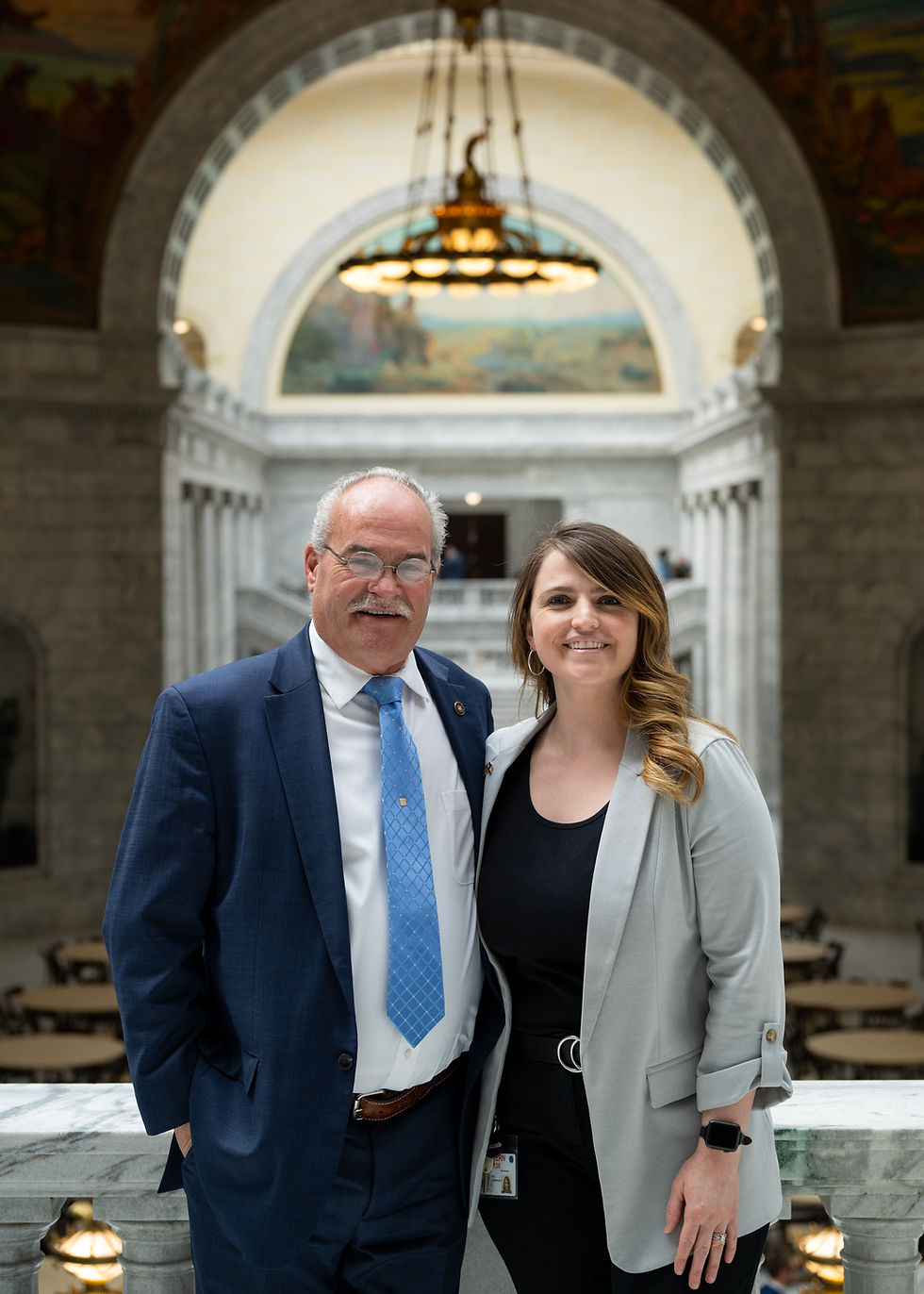
A Special Thanks to My Intern, Katie
Each year, talented students from universities across Utah come to the Capitol as legislative interns, bringing energy, curiosity and a desire to learn about the policymaking process. This session, I was fortunate to work with an outstanding intern, Katie, who played an important role in helping our office run smoothly.
From assisting with constituent meetings to answering calls and attending committee hearings, Katie approached every task with professionalism and enthusiasm. Her contributions made a real difference throughout the session.
Utah’s future is bright with dedicated young leaders like Katie, and I have no doubt she will continue to accomplish great things.
National Service Day on the Hill
We celebrated Utah’s spirit of giving back during National Service Day on the Hill. Service is a defining part of our state, and Utah continues to lead the nation in volunteerism. In fact, Utah is consistently ranked No. 1 for volunteer service.
I’m grateful for the many service organizations that help connect volunteers with individuals and families in need. I’m also thankful for those of you who give your time, resources and energy to helping your neighbors throughout the year. Your willingness to serve helps make Utah the best state in the nation to live, work and raise a family.
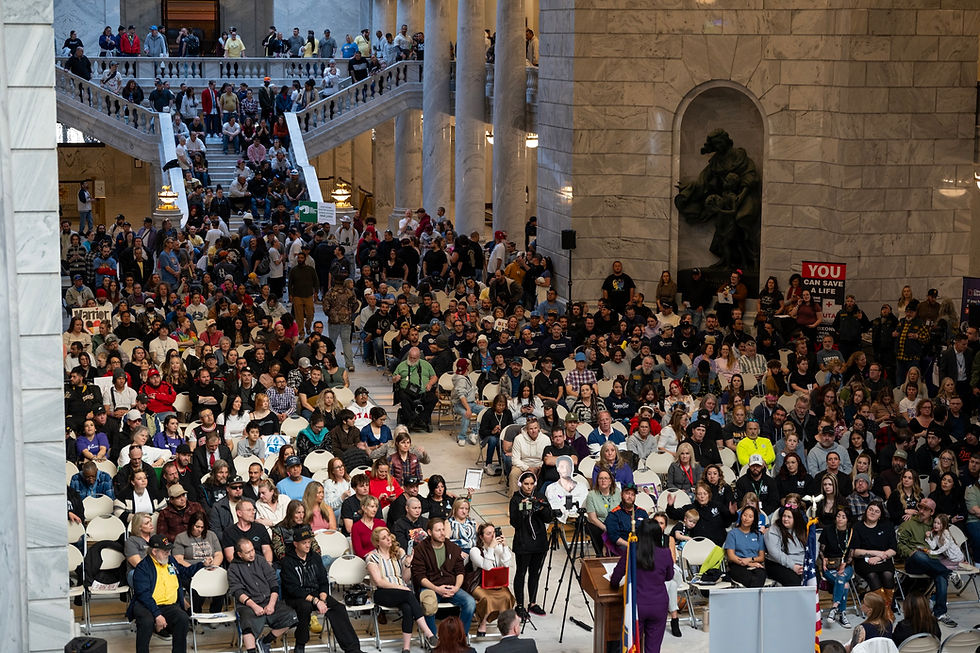
Rally for Recovery
The Capitol was filled with Utahns rallying in support of individuals and families navigating recovery. I was inspired by their resilience, their compassion and their commitment to strengthening their communities. We remain committed to advancing policies that expand access to mental health resources and support recovery for all who call our state home.
Legislation Highlights
Capital punishment cases are among the most serious and complex matters our judicial system handles. On average, a person spends about 22 years on death row in the United States. In Utah, that average is about 33 years.
Due process is essential, especially in capital punishment cases. However, cases should not drag on for decades while victims’ families wait for closure. The goal of this bill is to create a system that is fair, thorough and more efficient for victims, defendants and their families.
H.B. 495 and H.J.R. 28 are not about whether Utah should have the death penalty. Instead, it focuses on improving the legal process so capital felony cases move through the courts more efficiently while still protecting constitutional rights.
What It Does
Requires an early evaluation for intellectual disability so courts can handle disability appeals earlier in the process.
Establishes clearer timelines and procedures for how capital cases move through Utah courts.
Aligns Utah’s review process with federal standards, helping cases move more efficiently through state and federal courts.
Clarifies the appeals and post-conviction review process in capital cases.
Addresses issues identified in State v. Menzies by establishing guardrails for stays of execution related to competency.
Why It Matters:
Capital cases are among the most nuanced and resource-intensive in the legal system.
When processes are unclear, repetitive and delayed, cases can stretch for decades. This creates uncertainty for victims’ families, defendants and the courts.
Clarifying this process ensures the system protects constitutional rights and enables us to be good stewards of taxpayer dollars.
H.B. 42 School Cybersecurity Amendments
What It Does
In a growing digital world, it’s essential that schools proactively approach cybersecurity to keep student records secure and give families peace of mind.
Directs the state’s cybersecurity commission to set standards that protect student information, including grades, attendance records, health information and other sensitive student data.
Why It Matters
Schools hold sensitive, personal data about our children. If the data is breached, it can be misused, putting them at risk of identity theft and financial harm.
Recent breaches across the country have shown just how vulnerable school systems can be. Keeping Utah’s children safe from growing cybersecurity threats is essential to protecting their future.
H.B. 205 Substance Use Intervention Amendments
What It Does
Creates a coordinated system that helps local governments, health officials and treatment providers work together to address drug activity. This system includes:
The establishment of Stay Out of Drug Areas (SODAs) as a tool for law enforcement to restore order in areas where open-air drug activity has become common.
Allowing county jails to create recovery pods so people can start treatment while in custody rather than waiting until they are released.
Why It Matters
Substance abuse and overdose continue to affect families and communities across Utah.
Proactively addressing drug activity will protect neighborhoods while supporting those in long-term recovery.
H.B. 265 Non-nicotine Inhalation Product Amendments
Utah is seeing an increase in non‑nicotine inhalation products like flavored air devices, essential oil diffusers and “vitamin pens” being sold in our state. These products are often marketed as safer alternatives to vaping, but they fall outside traditional tobacco and vaping regulations. This bill addresses the registration of these inhalation products to better inform consumers about their ingredients and potential health impacts.
What It Does
Requires companies to register any non-nicotine inhalation products before selling them in Utah.
Creates civil penalties for selling or distributing an unregistered inhalation product.
Establishes a new criminal offense for illegally distributing inhalation products that contain cannabinoids.
Why It Matters
Without oversight, people in Utah communities may unknowingly consume products that are unregistered and potentially unsafe, even if they claim to be nicotine-free.
Setting consistent expectations for inhalation products helps consumers trust that the products they’re choosing have been properly regulated and have warnings if they contain any harmful ingredients.
Closing previous loopholes in the system helps keep unsafe or misleading cannabinoid products off the shelves, reducing the chance that people end up using something that could harm their health.
S.B. 267 Software in Education Amendments
What It Does
Requires the Utah State Board of Education to study how software and digital services are used in public schools.
Directs the Board to examine how software protects student data while also supporting active learning, skill development and measurable academic progress for students.
Requires the Board to publish guidance and best practices for schools on the responsible use of educational software.
Allows the Legislature’s Education Interim Committee to request a report on the study’s findings.
Why It Matters
Digital tools are now a regular part of the classroom, but not all software is designed with student learning and well-being in mind. This study helps ensure that schools are using technology that genuinely supports education.
The review will examine issues such as student data privacy, the role of software in classroom instruction and design features that may encourage excessive screen time rather than meaningful learning.
By gathering input from educators, parents, researchers and technology providers, Utah can develop thoughtful guidance that helps schools choose tools that promote real learning for generations of students.
S.B. 295 Intellectual Diversity in Education and Government
What It Does
Prohibits public schools, universities, and state agencies from requiring individuals to affirm ideological or political beliefs as a condition of employment, education or participation.
Requires student clubs and organizations to be treated consistently under viewpoint-neutral policies, ensuring all students have equal access to participate and organize.
Protects invited speakers and guest lecturers at Utah universities from viewpoint discrimination while allowing institutions to maintain standard event policies.
Encourages universities to host public policy events that include differing perspectives, while making event information publicly accessible.
Why It Matters
One of the core principles of a healthy republic is the freedom to exchange ideas. S.B. 295 helps ensure Utah’s public institutions remain places where open dialogue and respectful disagreement can thrive.
Intellectual diversity is essential to a healthy learning and working environment. Utah’s schools, universities and public institutions should be places where individuals can ask questions, explore ideas, and engage in respectful debate without pressure to adopt a particular political or ideological belief.
By protecting open discussion and reinforcing viewpoint-neutral policies, this legislation strengthens free speech and academic freedom while ensuring fair and consistent standards across our public institutions.
Encouraging universities to host events that feature differing perspectives on major policy issues also promotes transparency, civic understanding and greater trust in Utah’s higher education system.
H.C.R. 9 Concurrent Resolution Addressing the Great Salt Lake
What It Does
Utah is proactively leading one of the most ambitious environmental restoration efforts in the country.
Over the past several years, the state has invested millions into water Great Salt Lake recovery efforts.
This resolution builds on our momentum by requesting a formal federal-state partnership to accelerate restoration efforts and complement the work already happening in Utah.
Why It Matters
A partnership with the federal government would allow Utah to build on the strong foundation we already have in place.
Because the Great Salt Lake influences weather patterns, ecosystems and economic activity across the entire western region, restoring it is not just a state issue.
This is a regional challenge that requires strong collaboration, innovative solutions, and coordinated action
A project of this scale needs strong federal collaboration to match the significant investments.
National leaders are taking notice. The President posted on Truth Social that we will save the Great Salt Lake, and revitalizing the lake is “of tremendous interest” to him.
H.B. 597 Alcohol Amendments
What It Does
Requires restaurant licensees to check IDs only for alcohol-purchasing patrons who appear 35 years old or younger.
Allows more flexibility for patrons in hospitality settings, including carrying a drink between a bar and restaurant within 30 feet if both are under the same ownership.
Why It Matters
By making common-sense adjustments, the bill helps restaurants, hotels and retailers operate within the law more easily while maintaining Utah’s standards for oversight and public safety.
S.B. 45 Kratom Adjustments
Kratom, a highly addictive substance made from the leaves of a Southeast Asian tree, is sold in gas stations and smoke shops and marketed as a “natural” remedy for pain, anxiety or opioid withdrawal. In reality, it can act on the brain much like an opioid, creating dependence and withdrawal that mirror other addictive drugs. As formulations change and potency rises, these products are creating serious public health concerns in Utah and across the country.
What It Does
Moves kratom sales to tobacco specialty shops that verify IDs, raises the purchase age from 18 to 21, and requires kratom products to be kept behind the counter.
Updates Utah’s kratom laws to address newer, highly concentrated products now appearing in gas stations and convenience stores.
Keeps natural kratom leaf available for adults while prohibiting products made with higher, more intense forms of 7-OH, the ingredient that makes some of the newer versions much more powerful.
Why It Matters
Many people don’t realize how different today’s concentrated kratom products are from traditional kratom leaf. Some of the products sold in gas stations are far more potent and have been linked to serious health concerns, yet they’re often displayed near everyday items like energy drinks and snacks.
It’s important consumers know what they’re buying, and higher-risk products are kept out of places families visit every day, while still allowing adults to access natural kratom leaf.
H.B. 273 Classroom Technology Amendments
What It Does
We’ve learned that technology in the classroom works best when used intentionally, not just more often.
This bill allows school districts to set classroom technology policies that include low-tech options and meet local needs.
Encourages device-free lessons for early reading, writing and math.
Requires schools to provide support for students who struggle with screens, including low-tech options when needed.
Why it Matters
After years of rapid classroom technology adoption, parents and teachers are asking an important question: Are devices helping students learn, or just adding more screen time?
Parents and teachers want reasonable, age-appropriate limits that help students focus and build healthy technology habits.
H.B. 498 Utah App Store Accountability Act Amendments
What It Does
Some apps operate under a single family account, which can cause all profiles to default to the youngest child’s age. This bill allows parents to update each child’s profile after setup so older teens can have appropriate access while younger children remain protected.
Why It Matters
Last year, Utah passed the App Store Accountability Act to protect minors from harmful online content. This bill builds on that effort by giving parents more practical tools to manage their children’s digital experiences.
Instead of tech companies deciding what kids can see, parents can set boundaries that reflect their family’s values to protect children and allow appropriate access.
H.B. 84 Dangerous Weapon Amendments
What It Does
Clarifies Utah law regarding firearms on public college and university campuses.
Adults 21 and older who can legally carry a firearm without a permit in most public places can also carry concealed on college campuses. Open carry would not be allowed.
This change applies only to colleges and universities. It does not change the rules for other restricted places set in Utah law, such as K-12 schools.
Why It Matters
For those who choose to exercise their constitutional right to carry, the same concealed-carry rules that apply in most public places will now apply on college campuses.
Clarifying the law ensures that constitutional rights are protected, while addressing concerns about visible firearms on campus.
Over the past year, confusion around open carry on college campuses created uncertainty for students, staff and law enforcement. This bill provides a clear, consistent standard by requiring firearms on campus to be concealed.
H.B. 190 Child Care Business Tax Credit
Childcare has become so expensive and scarce that it shapes how Utah families live, whether parents can work and if young couples can even afford to have children. With infant care costing over $11,000 a year, more than in-state college tuition in many cases, 64% of Utah families have both parents in the workforce, yet the state loses $1.36 billion annually in wages and productivity due to childcare gaps.
What It Does
Utah parents need more flexibility and options when it comes to caring for their children.
Creates a tax credit that rewards businesses when they help pay for employee childcare, making it cheaper for companies to offer childcare support like subsidies, on-site centers or facility improvements.
Boosts the credit from 25% to 50% of childcare costs, matching recent federal improvements, so Utah businesses can take full advantage of new national incentives.
Focuses on small businesses, encouraging more local employers to voluntarily invest in childcare that helps their workers and nearby families.
Why It Matters
Childcare costs have risen quickly in recent years, that they are shaping major family decisions, including whether both parents can work, or if young couples feel they can afford to have children.
When childcare isn’t available or affordable, families lose income, businesses struggle to hire and the state loses productivity. The practical partnership created by this bill between employers and families will help parents stay in the workforce while expanding childcare options in our communities.
H.B. 218 Digital Skills Amendments
What It Does
In today’s digital world, it is vital for students to understand how the internet and online platforms work.
Currently, all 7th- and 8th-graders in Utah take a required digital literacy course that covers basic computer and online skills.
This bill expands the curriculum so it focuses on how to safely and responsibly navigate emerging technologies, including social media use, AI literacy, digital privacy, cybersecurity, screentime management and cyberbullying prevention.
Why It Matters
Junior high is often when students first become heavily involved with smartphones and social media, making it a critical time to learn to use technology responsibly.
By modernizing this course, Utah students will have practical tools to stay safe and make smarter choices online.
H.B. 89 Use of Polygraph Amendments
What It Does
Prohibits law enforcement officers, prosecutors, courts or other government officials from requesting or requiring a sexual assault victim to take a polygraph test during a criminal investigation.
Why It Matters
Polygraph tests are unreliable and generally inadmissible in court, yet victims may feel pressured to take them during investigations.
Trauma responses can be misinterpreted as deception, potentially harming victims and complicating investigations.
Removing this practice helps protect survivors and encourages reporting of sexual assault.
At least 28 states already restrict or prohibit polygraph testing of sexual assault victims, and this bill brings Utah in line with national best practices.
H.B. 412 Energy Development Planning Amendments
What It Does
Requires wind and solar developers to check with wildlife experts before building large projects on valley floors where animals live and migrate.
Helps local officials receive clear information about potential impacts on deer, birds and other wildlife when making large-scale energy permitting decisions.
Why It Matters
Large wind and solar projects built on valley floors can disrupt migration routes and pose risks to birds and other wildlife if not properly planned.
This bill helps balance clean energy development with wildlife conservation by ensuring local officials have expert information when evaluating projects.
It promotes responsible energy development that protects Utah’s natural landscapes and wildlife habitats while allowing renewable energy to grow.
H.B. 170 School Board Referendum Amendments
What It Does
Allows voters to challenge certain school board tax increases or legislative actions by gathering signatures to place the issue on the ballot for a public vote.
Creates an exception for measures approved by a school board with a supermajority vote, allowing those decisions to move forward without a referendum.
Establishes clear signature thresholds and timelines so residents understand how and when a referendum process can occur.
Why It Matters
School tax and policy decisions directly affect families, homeowners and local taxpayers.
This bill provides residents with a clear process to request a public vote on major decisions when there is significant community concern.
By increasing transparency and public participation, the bill strengthens accountability while preserving the ability of school boards to act when there is strong consensus.
ICYMI:
Legislation envisions Utah being a key critical minerals player
Governor Cox signs nine more bills from the 2026 General Legislative Session
To improve early literacy outcomes, Utah proposes $16 million for interventions
Lawmaker seeks to drop licensing requirements for 4 professions
Utah moves toward allowing health care providers to deny treatment based on their beliefs

Thank you for your engagement throughout the session and for sharing your voice. As we move into the interim and begin preparing for next year, I look forward to staying connected and continuing to work together to keep Utah strong and moving forward.
Best,
Ron Winterton


soicauxsmb.com hôm trước thấy bạn gửi nên mình bấm vào nghía thử cho biết, kiểu xem họ làm trang ra sao thôi. Vào cái là thấy giao diện khá “dễ thở”, không bị nhồi chữ hay màu mè quá nên nhìn đỡ mỏi mắt. Mình để ý cách họ chia nội dung thành từng khối rõ ràng, lướt xuống là biết đoạn nào thuộc phần nào, không phải căng mắt tìm. Thanh menu cũng nằm chỗ dễ thấy nên chuyển qua lại nhanh, không bị lạc hay phải bấm lui tới nhiều. Nói chung cảm giác dùng khá mượt, nhất là mấy khối thông tin xếp theo cột nhìn gọn và dễ theo dõi trên trang.
sunwin mình ghé qua thử cho biết vì thấy bạn bè nhắc hoài, chứ cũng không định ngồi lâu. Vào trang cái là thấy họ làm bố cục kiểu chia khối rõ ràng, mỗi phần tách bạch nên mắt không bị ngợp chữ. Mình lướt trên điện thoại thấy cuộn khá mượt, bấm chuyển mục cũng nhanh, không bị giật hay phải chờ load lâu. Nói chung kiểu giao diện nhìn hiện đại nhưng vẫn dễ hiểu, mới vào là biết nên nhìn chỗ nào trước. Mấy tiêu đề với ô nội dung được căn gọn theo dạng block nên kéo xuống đọc rất lẹ.
https://soicau247.com/soi-cau-3-cang-mien-bac.html mình vô tình thấy link này trong group nên bấm vào xem cho biết, kiểu xem giao diện là chính chứ không ngồi đọc kỹ. Ấn tượng đầu là trang chia mục nhìn khá rõ, kéo xuống không bị rối mắt. Có phần mục lục ở trên nên muốn nhảy nhanh qua đoạn “soi cầu 3 càng là gì” hay phần thống kê thì bấm cái là tới, đỡ phải lướt mỏi tay. Mình cũng thích cách họ trình bày số liệu theo dạng bảng/cột, nhìn phát nắm được ngay chứ không phải dò từng dòng chữ. Nói chung trải nghiệm lướt ổn, chữ dễ đọc, các khối nội dung tách bạch và bảng thống kê theo cột nhìn…
tỷ lệ kèo nhà cái 55 mình thấy mọi người nhắc hoài nên cũng bấm vào xem thử cho biết. Mình không phải kiểu ngồi phân tích kèo kỹ đâu, chỉ cần nhìn nhanh mà nắm được thông tin là ok. Vào trang cái mình để ý ngay là họ làm bảng kèo dạng cột nhìn khá thoáng, tách rõ phần cả trận với hiệp 1 nên đỡ bị loạn mắt. Lướt xuống còn có đoạn giải thích “kèo nhà cái là gì” chèn ngay trong bài, đọc vài dòng là hiểu sơ sơ chứ không phải đi tìm chỗ khác. Điểm mình thích là bảng tỷ lệ được cập nhật theo các trận trong ngày, nhìn cái là thấy…